Tech
Why Does AI Prefer Markdown Over HTML in 2026
Learn why AI models like ChatGPT, Claude, and GitHub Copilot prefer Markdown over HTML — better structure, token efficiency, and its role in RAG systems.
June 20, 2026 - 6 min read - Admin
Why Does AI Prefer Markdown Over HTML in 2026?
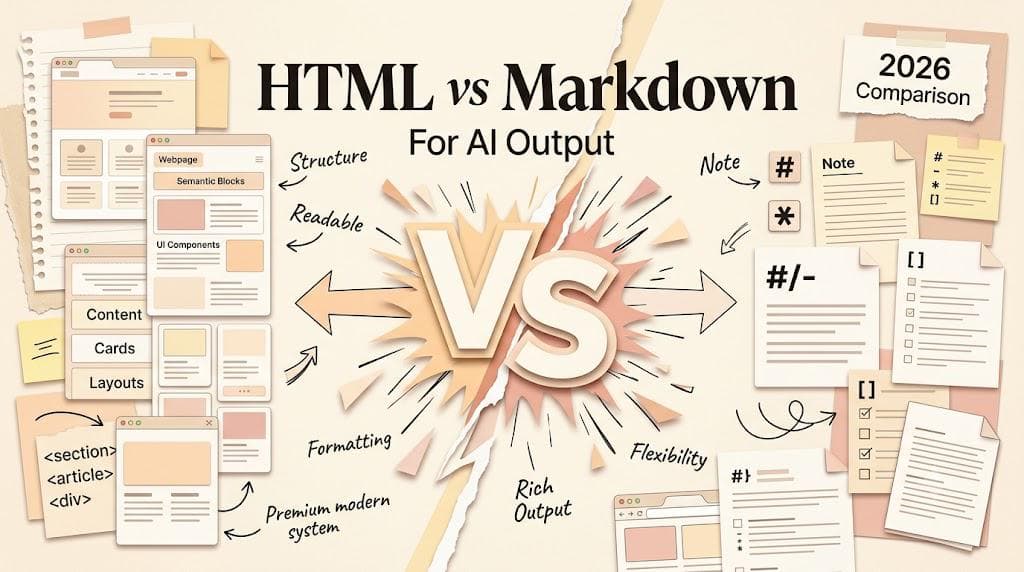
If you have ever asked ChatGPT or Claude a question, you have probably noticed that the response comes back with clean headings, bullet points, and bold text. That is not an accident — it is Markdown, and by 2026 it has quietly become the unofficial default format across the AI industry. In this article, we will break down why AI models prefer Markdown over HTML, the technical reasons behind it, and why developers keep choosing this format for AI-powered applications.
What Is Markdown?
Markdown is a lightweight markup language created by John Gruber in 2004, designed to let people add formatting to plain text without writing complex HTML tags. The idea is simple: a hash symbol (#) creates a heading, double asterisks (bold) make text bold, and a dash (-) creates a list item. If you want to see the exact syntax rules, the <a href="https://commonmark.org/">CommonMark specification</a> is a solid reference that documents every detail.
Today, Markdown is used everywhere — GitHub README files, blogging platforms, note-taking apps, and technical documentation sites — because it is fast to write and easy to read.
Why AI Models Prefer Markdown Over HTML
When a large language model (LLM) generates a response, it essentially has two choices: structured markup like HTML, or lightweight syntax like Markdown. Most modern AI systems lean toward Markdown because that is also what dominates their training data — GitHub repositories, Stack Overflow answers, and technical docs are mostly written in Markdown.
The second major reason is that Markdown is far less verbose. HTML requires opening and closing tags for almost everything (<h1>...</h1>), while Markdown needs just a single symbol (#). That difference looks small on paper, but when a model is generating millions of responses, this kind of efficiency adds up fast.
Better Structure and Readability
Markdown's biggest strength is that it gives content a predictable hierarchy. Headings (#, ##, ###) define the document's structure, lists organize information, and code blocks visually separate technical content. This means the AI model always knows what counts as a heading, what counts as an explanation, and what counts as an example — without needing extra parsing logic.
The same applies to humans reading the output: visual hierarchy is instantly recognizable, whereas raw HTML can feel cluttered to anyone who isn't a developer.
Easier Parsing for LLMs
HTML can include nested tags, attributes, inline styles, and even scripts — all of which add noise that a model has to process. Markdown is much simpler by comparison: its syntax is flat and follows predictable patterns, which makes it easier for a model to generate valid output consistently.
When a model generates HTML, forgetting to close a single tag can break the entire layout. With Markdown, that risk drops significantly because each formatting element is small and self-contained.
Token Efficiency: Doing More With Fewer Tokens
AI models process text as "tokens," and every token has a cost — whether that's processing time or API pricing. HTML tags (like <div class="container">) consume a lot of tokens that add no real value to the actual content. Markdown achieves the same formatting in just one or two characters.
This difference might not matter for a short message, but when AI applications are processing thousands of documents, token efficiency directly impacts both cost and speed. That's exactly why most API-based AI tools default to Markdown as their output format.
The Role of Markdown in RAG Systems and AI Agents
Retrieval-Augmented Generation (RAG) systems need to break documents into smaller chunks so they can be searched through embeddings. Markdown's clear heading structure makes this chunking process much easier, since each section's boundaries are already defined.
AI agents also rely heavily on Markdown when passing information to each other or returning a tool's output, since it keeps the result readable for both machines and humans. In multi-step workflows, where one agent's output becomes another agent's input, this consistency is essential.
Why Developers Use Markdown for AI Applications
Developers have several practical reasons for choosing Markdown:
- Readable by both humans and machines — no extra rendering tool is needed to understand it.
- Git-friendly — Markdown file diffs stay clean and readable, while HTML diffs quickly turn messy.
- Easy conversion — Markdown converts cleanly into HTML, PDF, or virtually any other format.
- Less escaping required — embedding Markdown text inside JSON or API responses is far simpler than embedding HTML.
- Wide tool support — almost every documentation platform, chat interface, and code editor supports Markdown natively.
These are exactly the reasons chatbots, coding assistants, and documentation generators default to Markdown as their output format.
Real-World Examples: ChatGPT, Claude, GitHub, and Documentation Systems
A few real-world examples make this pattern obvious:
- ChatGPT generates its responses in Markdown by default — headings, bullet points, and code blocks all follow this format.
- Claude follows the same approach; Anthropic's <a href="https://docs.claude.com">official documentation</a> itself is built on a Markdown-based structure.
- GitHub uses Markdown for every project's README.md file, and GitHub's own <a href="https://docs.github.com/en/get-started/writing-on-github">writing and formatting guide</a> follows the same standard.
- Documentation systems like Docusaurus, MkDocs, and GitBook also treat Markdown as their core content format because it's scalable and easy to maintain.
All of these examples point to the same conclusion: wherever AI and structured content intersect, Markdown becomes the default choice.
Frequently Asked Questions
Why does AI prefer Markdown over HTML? Because Markdown is lightweight, predictable, and token-efficient, allowing AI models to generate clean, structured output without extra parsing complexity.
Can Markdown completely replace HTML? No, each format has its own use case. Markdown works best for content authoring, while HTML remains essential for web rendering and complex layouts.
Where do AI models learn Markdown formatting from? The training data used to build LLMs already contains a huge volume of GitHub repos, technical docs, and online articles written in Markdown, which is how models pick up the pattern.
Is Markdown good for SEO? Yes, because its clean heading structure helps search engines understand content more easily, and pages load faster since there's no extra markup overhead.
Final Thoughts
Markdown isn't just a formatting style anymore — it has become a practical standard for the AI era. Better readability, easier parsing, token efficiency, and smooth integration with RAG systems are all reasons why both AI models and developers prefer Markdown over HTML. If you're building AI applications or writing content meant to interact with an LLM, adopting Markdown is a smart move.
Related Guides
Want to learn more? Check out these guides:
- 📖 How to Make Money with AI as a Beginner
- 💼 High-Income Skills to Learn in 2026
- 💻 AI Coding Tools to Build Websites and Earn Money
- 🎬 How to Build a Faceless YouTube Channel
- ⚡ Top AI Tools to Double Your Productivity
- 📈 How to Rank Your Blog on Google in 2026
- 🤖 AI Automation for Small Businesses: Benefits and Use Cases
- 🔍 How to Find Low-Competition Keywords That Rank
- 🧭 What is SEO and How It Works (With Examples)